Monday, May 30, 2011

Last Monday in May

It's SO beautiful today - light breeze, balmy, sunny, the air scented with flowers and wood smoke. Ken bought a brisket at McCall's Meat and Fish Company on Hillhurst and is smoking it for dinner. I just had a bite and it's out of this world. McCall's is a nod to my not being able to stomach factory farmed meat anymore. I rarely eat meat, so when I do I want it to be good.

I've been doing garden cleanup and planting seedlings today.


I grew these nettles from seed and planted 4 behind the barn and two beside the bridge - out of the way. They're just big enough now to sting. I've never felt that before - very cool, and surprisingly lasting. I'm very into weeds this year and so nettles were on the top of my list. I'm also growing 2 kinds of plantain - the seeds gathered curbside. I've transplanted them to a mixture of our clay soil and amendment as they don't need that rich of a soil.


This is angelica that I've also grown from seed. I've planted this one near the bridge, an area amply shaded which I can easily keep moist. The angelica will not bloom this year, but I'm patient. I was smitten with it on my Tennessee Valley walks in Marin County, CA. It grows wild there. Next time I go I'll try to pinch a few seeds.


This is "french hollyhock" (malva sylvestris), a weed around here, but one with which I am deeply in love. It's a mallow and has large round leaves. Even though it rusts the rust does not spread to other plants. It has been a wonderful nurse plant to my tomatoes.


I caught this bee reveling in a California poppy. I hope it's one of our bees, though I fear all ours are gone.


Here are our new hives, awaiting starter strips and wax. I've been told that bees leave 50% of the time, so I figure if we have two hives we have a better chance of one of them being occupied.

Happy Memorial Day weekend, everyone!

Fava Harvest


I harvested our fava beans yesterday to make way for squash. I'm trying zephr squash, which is like a zucchini but yellow with a green bottom. It looks dipped in green, like an Easter egg. The other is from seeds that Erik Knutzen of Root Simple gave us - Lunga di Napoli, aka squash baby. If I'm successful I might try to find foster homes for any extra babies.

I'm also growing trombetta again this year, but against the barn as it needs to climb. Again, like zucchini but a more delicate flavor and very pale and pretty on the plate.

So, back to the fava beans. I cut them at the ground, leaving the roots in tact. I pulled off the bean pods, later shelled them, then boiled them, then squeezed them out of their leathery wrappings. What I considered a bumper crop equaled about 2 cups. They do taste good though so I will be doing these again.

The labor involved took me back to my childhood. Mothers, grandmothers and aunts sitting at oilcloth covered tables in the dappled sunlight, gossiping and preparing food. It would be much nicer to do these chores with other farm guys and gals. All in good time.

Sunday, May 29, 2011

Ahem...


My husband keeps singing the praises of hand-powered washing machines. Should I be worried?

Cover Corpse


Nothing says Spring like the pungent scent of the Dracunculus Vulgaris (also known as the "dragon arum" or "voodoo lily" or "corpse flowers") in bloom. This strange and lovely flower is about between 12" and 18" long with a single leaf. It's related to the Amorphophallus (shapeless penis) Titanum (big!) which we visited at the Huntington one year, and smells just as bad. The scent of rotted meat wafts down the hill in the heat drawing flys and all kinds of bugs eager to travel inside. Though we have three plants, two of which bloom faithfully year after year, they're more like cover corpse than cover crops.

I Really Love Your Peaches


After hearing C. Darren Butler speak at the Huntington last year we were eager to plant fruit trees. While at Home Depot we saw cans of peach trees for $5.99 so bought one. I felt guilty thinking it probably came from China, or was GMO or grown with hormones or something, but we just couldn't wait.

This spring our little peach, which started out as a 12" stick in the ground, gave us a half dozen mini peaches of superb flavor. Really, who can't admire the effort of this tree, regardless of its origins?

This weekend we bought a David Wilson peach tree and will plant it at the top of the yard. It's larger and more developed. That gives us 2 apple trees, 2 figs (mission and kadota), 2 pomegranates, a persimmon, a lemon, an avocado and a kumquat. Next year we want to plant 2 cherries, 2 sea buckthorns, a pineapple guava and an almond tree.

I'm really loving the whole food forest idea.

Plant guild?


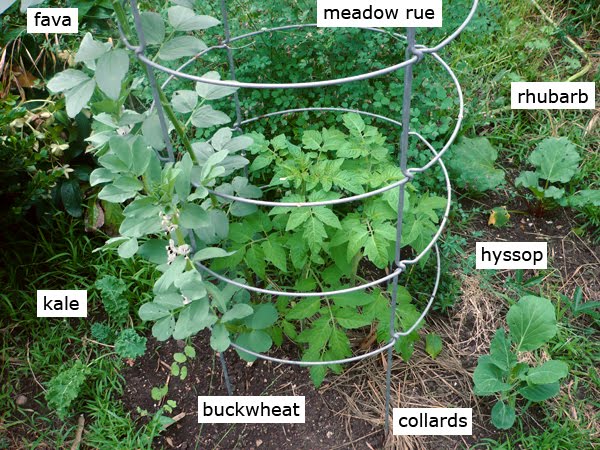
Who knows exactly why this tomato plant is doing so much better than all the others, but it could be the good company it keeps.

The tomato was sandwiched between nurse plants fava and meadow rue (Theordore Payne) in hopes of keeping the critters away, which seems to have worked. The rhubarb came from Winetka Farms and Craig Rugless told me to put it in a shadier, moister spot. It's thriving - a first for me. I usually kill my rhubard straight away, which is too bad as it's one of my very favorite plants both for eating and looking at.

The buckwheat is cover crop and bee fodder. The rest I just planted haphazardly.

I'll let you know how this turns out as the summer wears on.

Friday, May 20, 2011

19th Century Bee Fever


I found a cache of lovely bee-keeping images at Google Books and posted them online at Backwards Beekeeper.

I was looking for stories about honey caves - huge caves, filled with hives maybe 100s of years old. These pristine caves were mined with dynamite by pioneers and settlers who wanted to remove as much honey as they could. But imagine the scent and the noise in a honey cave.

The photos I've posted come from various bee-keeping journals which explicitly speak of bee fever - a phenomenon as real then, as now.