Sunday, May 29, 2011

I Really Love Your Peaches


After hearing C. Darren Butler speak at the Huntington last year we were eager to plant fruit trees. While at Home Depot we saw cans of peach trees for $5.99 so bought one. I felt guilty thinking it probably came from China, or was GMO or grown with hormones or something, but we just couldn't wait.

This spring our little peach, which started out as a 12" stick in the ground, gave us a half dozen mini peaches of superb flavor. Really, who can't admire the effort of this tree, regardless of its origins?

This weekend we bought a David Wilson peach tree and will plant it at the top of the yard. It's larger and more developed. That gives us 2 apple trees, 2 figs (mission and kadota), 2 pomegranates, a persimmon, a lemon, an avocado and a kumquat. Next year we want to plant 2 cherries, 2 sea buckthorns, a pineapple guava and an almond tree.

I'm really loving the whole food forest idea.

Plant guild?


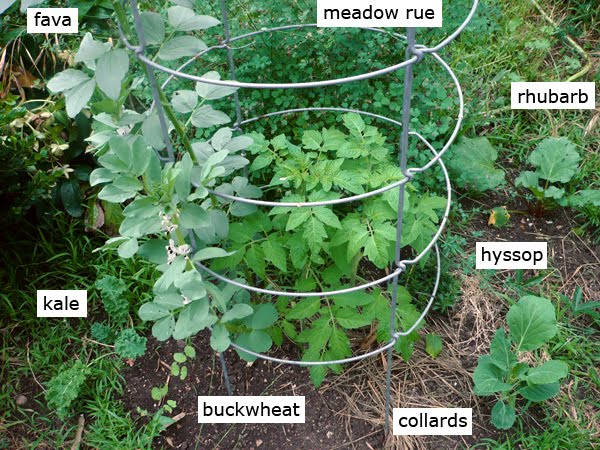
Who knows exactly why this tomato plant is doing so much better than all the others, but it could be the good company it keeps.

The tomato was sandwiched between nurse plants fava and meadow rue (Theordore Payne) in hopes of keeping the critters away, which seems to have worked. The rhubarb came from Winetka Farms and Craig Rugless told me to put it in a shadier, moister spot. It's thriving - a first for me. I usually kill my rhubard straight away, which is too bad as it's one of my very favorite plants both for eating and looking at.

The buckwheat is cover crop and bee fodder. The rest I just planted haphazardly.

I'll let you know how this turns out as the summer wears on.

Friday, May 20, 2011

19th Century Bee Fever


I found a cache of lovely bee-keeping images at Google Books and posted them online at Backwards Beekeeper.

I was looking for stories about honey caves - huge caves, filled with hives maybe 100s of years old. These pristine caves were mined with dynamite by pioneers and settlers who wanted to remove as much honey as they could. But imagine the scent and the noise in a honey cave.

The photos I've posted come from various bee-keeping journals which explicitly speak of bee fever - a phenomenon as real then, as now.

Friday, May 13, 2011

Bee Rescue


We got our bees yesterday, thanks to Maurice, Ed, Chris and Zach. Thanks, guys.

It was a dirty, hot, four hour job and we're both completely exhausted today.

Monday, May 9, 2011

Faux-plait


My son is addicted to Yoplait. It's a yogurt-like substance. I serve it as part of a balanced breakfast, though I can no longer bear to lick the spoon after I've disgorged it from its plastic tomb.

Our son did not arrive at our home at birth so we were unable to raise him with a taste for real food. I don't know if we would have raised him thus anyway as my commitment to proper food waxes and wanes, often sidelined by a drive through local Filipino and Thai neighborhoods, scented as they are with intoxicating barbecue. Still, every morning as I ply the Yo-paste from its white ty-d-cup I sigh. Then I scoop kibble from a colorful box for the boy, followed with a scoop of kibble from a bucket for the cats. I'm feeding my boy as if he were factory farmed.

The food preferred by the boy is sweetened, yes, but it is also predigested. It is meant to dissolve like cotton candy in the mouth requiring no effort from the teeth or jaws, no thought that leads the imagination to the cow or goat and to the land that sustains them and us.

This morning I created version 2.0 of faux-plait. I took Trader Joe's Greek yogurt - cuisinarted in 4 frozen strawberries, 1/8 cup of sugar, and vanilla. It tastes better than Yoplait, but there is that sour aftertaste which I fear will derail the experiment. It still actually tastes like yogurt.

I'm convinced that industrial food is meant to distance us from real food to the extent that we will no longer be satisfied with real food. We will not look to the earth or our animals for sustenance, but to groups of pathologically greedy men seeking to sell us pre-eaten food disguised with sugar, covered in lard, and injected with vitamins and the hot nutrient du jour. If we balk, they'll throw in a toy.

Everyone who cannot feed herself or himself will be at the mercy of the pathologically greedy men. They are invisible, hiding behind the fiction of the corporation. Our food - which once represented our covenant with the earth - is mystified. No one knows where Yoplait comes from - it's magic. Don't question the system or it might all go away. Just be grateful.

Epilogue: The boy likes the faux-plait. Now I'll slowly wean him off the sugar in it.

Bee hives in place


Our new bee hives are in place - waiting for bees. Yesterday, while it was still cool, we hiked to the top of our hill and placed 4 redwood 4x4s. The purpose is to hide the hives from the neighbors on the opposite hill, and to encourage the bees to fly up, rather than out. We'll train grapes and other vines over the structure - to keep the hives cooler in the baking summer.

I'm planting buckwheat, sunflowers, and comfrey all around the beehive - a sort of 7/11 for bees too tired or lazy to forage far from home.

Wednesday, May 4, 2011

Lessons from Genesis

Arguments about tilling versus no tilling have been making the rounds lately.

This brought to mind verses from Genesis regarding the tilling of the earth and I reread chapters 2 and 3, which both refer to what appears to be a permaculture system (pre-fall):

"And every plant of the field before it was in the earth, and every herb of the field before it grew: for the LORD God had not caused it to rain upon the earth, and there was not a man to till the ground." Genesis 2:5

...and a tillage system (post-fall):

"Therefore the LORD God sent him forth from the garden of Eden, to till the ground from whence he was taken." Genesis 3:23

It appears that the garden of Eden was a sort of food forest "dressed" (Genesis 2:15) by Adam and Eve. Tilling did not begin until the couple was ejected from Eden. Tilling seems to be central to God's curse against Adam,

"...cursed is the ground for thy sake; in sorrow shalt thou eat of it all the days of thy life; Thorns also and thistles shall it bring forth to thee; and thou shalt eat the herb of the field; In the sweat of thy face shalt thou eat bread, till thou return unto the ground; for out of it wast thou taken: for dust thou art, and unto dust shalt thou return." Genesis 3:17b-19